- This piece was originally published by Agencia Publica, and has been translated and edited by openDemocracy
As night fell on Rio de Janeiro on 13 March 1964, Brazilian President João Goulart, known as Jango, addressed a crowd gathered at Brazil’s Central Station to announce measures that would change the course of the country’s history.
His speech, focused on restricting the profits that foreign companies in Brazil could send abroad and promising agrarian reform, resonated not just in the streets, but also in the offices of Brasília, at the headquarters of foreign corporations in the country and in the corridors of Washington.
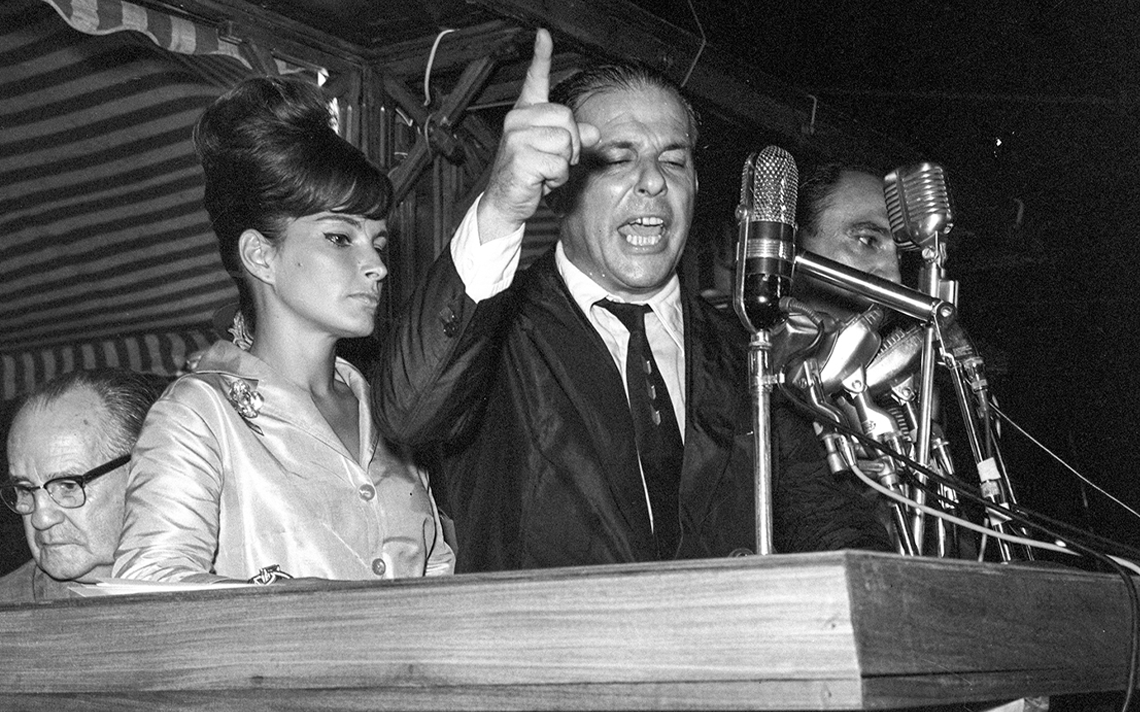
Goulart also spoke about religion and politics. Days earlier in the city of Belo Horizonte in south-east Brazil, the Labour Party’s federal deputy and the president’s brother-in-law, Leonel Brizola, had been prevented from speaking by a group of women brandishing rosaries as shields against what they saw as a communist threat.
“The rosaries of faith must not be raised against the people,” Goulart warned in his speech at the Central de Brasil.
The response to his warning would come less than a week later, not in the form of silent prayers, but in the roar of half a million people marching through the streets of São Paulo city on the afternoon of 19 March, the feast day of St Joseph, patron saint of the family.
The March of the Family with God for Freedom, a name suggested by the nun Ana de Lurdes, who considered it “an act of faith in a time of darkness”, began in Praça da República at four in the afternoon and proceeded towards Praça da Sé, a square at the heart of São Paulo, dominated by the city’s neo-Gothic cathedral.
The demonstrators carried banners that combined religious devotion with visceral anti-communism: “Our Lady of Aparecida, enlighten the reactionaries”, “Red only on lipstick”, “Green and yellow, no hammer and sickle”.
What appeared to be a spontaneous demonstration by concerned believers was, in fact, the result of a much more complex organisation and came together within a context of intense political polarisation, says Janaína Cordeiro, who studied the activities of conservative women’s groups during that period as part of her PhD in History at the Federal University of Fluminense.
“The first march took place in São Paulo and was conceived as an act of reparation for the rosary, which had allegedly been offended by Jango at the rally in Central de Brasil on 13 March,” Cordeiro explains.
These women – middle-class housewives and primary school teachers – organised themselves quickly. “They were mainly housewives and, if they had a profession, it was linked to care work, which by then had been considered a female domain.”

It took just five days to organise the march, which was backed by figures such as federal MP Antônio Sílvio da Cunha Bueno of the Social Democratic Party and the deputy governor of São Paulo, Laudo Natel. Meanwhile, São Paulo governor Adhemar de Barros was raising funds from the business community at the headquarters of the Federation of Industries of the State of São Paulo to equip the security forces and ensure order during the event.
Ultimately, the march helped to bring down Goulart’s government, having demonstrated the public support for the military coup that would depose him less than two weeks later. Yet documents and the testimony of former US Central Intelligence Agency agent Philip Agee indicate that this march, and the others that followed in the days after, were not only organised at a grassroots level by housewives, but had the backing of the CIA itself.
The CIA not only allegedly provided funds to some of the organisers – including the Brazilian Institute for Democratic Action, the Institute for Social Research and Studies, the Women’s Campaign for Democracy, the Fraternal Urban and Rural Friendship, and the Brazilian Rural Society – but is said to have helped to plan the demonstrations. Brazil’s business sector is also thought to have funded some of these groups.
A document on the family marches compiled by Rodrigues Matias and published by the magazine Caros Amigos in 2002 states that “João Batista Leopoldo de Figueiredo, president of the Institute for Social Research and Studies, was one of the key figures in organising the movement”.

The ‘CIA priest’
The story of an Irish priest who believed he had been saved by a miracle also explains how faith became a tool of US foreign policy.
Patrick Peyton, a member of the Congregation of the Holy Cross, an international congregation of the Catholic Church, contracted tuberculosis during his priestly training in the United States. When he recovered, he attributed his salvation to the intercession of the Virgin Mary and the Rosary. From then on, Peyton dedicated his life to promoting a transnational devotional movement, the Family Rosary Crusade, which would become one of the most sophisticated instruments of US influence in Latin America during the Cold War.
The priest produced films and radio programmes to spread devotion to the Rosary. In 1962, when he arrived in Brazil, his Family Rosary Crusade became a vehicle for far-reaching political mobilisation against communism.
There, the Crusade was not led by men in suits and ties, but by women from lay Catholic groups, who opened offices in Recife, Rio de Janeiro, Salvador, Paraná and Belo Horizonte, and organised themselves into groups that multiplied rapidly.
The Women’s Civic Union began its activities in 1961 in São Paulo, establishing branches in the interior of the state, in Santos and other cities. In Rio de Janeiro, six months later, the Women’s Campaign for Democracy was founded, which quickly expanded its branches to other neighbourhoods and cities in the region.
But there was one crucial detail: many of the husbands, brothers and male relatives of these women were military personnel, businessmen linked to the Institute for Social Research and Studies and Brazilian Institute for Democratic Action, or executives of multinational corporations.
Janaína Cordeiro points out that, although women played a very strong and important leadership role in that context, these other organisations were also fundamental. “They relied on what was known at the time as the ‘productive classes’; they relied on sectors of the business community; they relied on some organised trade unions that also called for the march; they relied on other churches besides the Catholic Church.”
Although the Marches of the Family with God and Freedom were led by the women’s groups, not the Family Rosary Crusade, they supported the Crusade, which fuelled anti-communist rhetoric against Jango.
Historian Isabella Villarinho Pereyra, who holds a PhD from the Federal University of Rio de Janeiro, highlights the central role that this religious organisation played in the 1964 coup.
“The marches served as a kind of collective catharsis for this group of women, who had a very specific agenda: to save Brazil from communism,” explains Pereyra. In this context, “a narrative of a battle waged against communism not only on the military front, but also on the spiritual front”.
The rosary was not merely a religious symbol. It was the only weapon able to save the country. “The women who marched believed they were drawing on every possible form of support, mobilising not only faith but also the media, parishes, masses and the structure of the Catholic Church,” notes Pereyra.

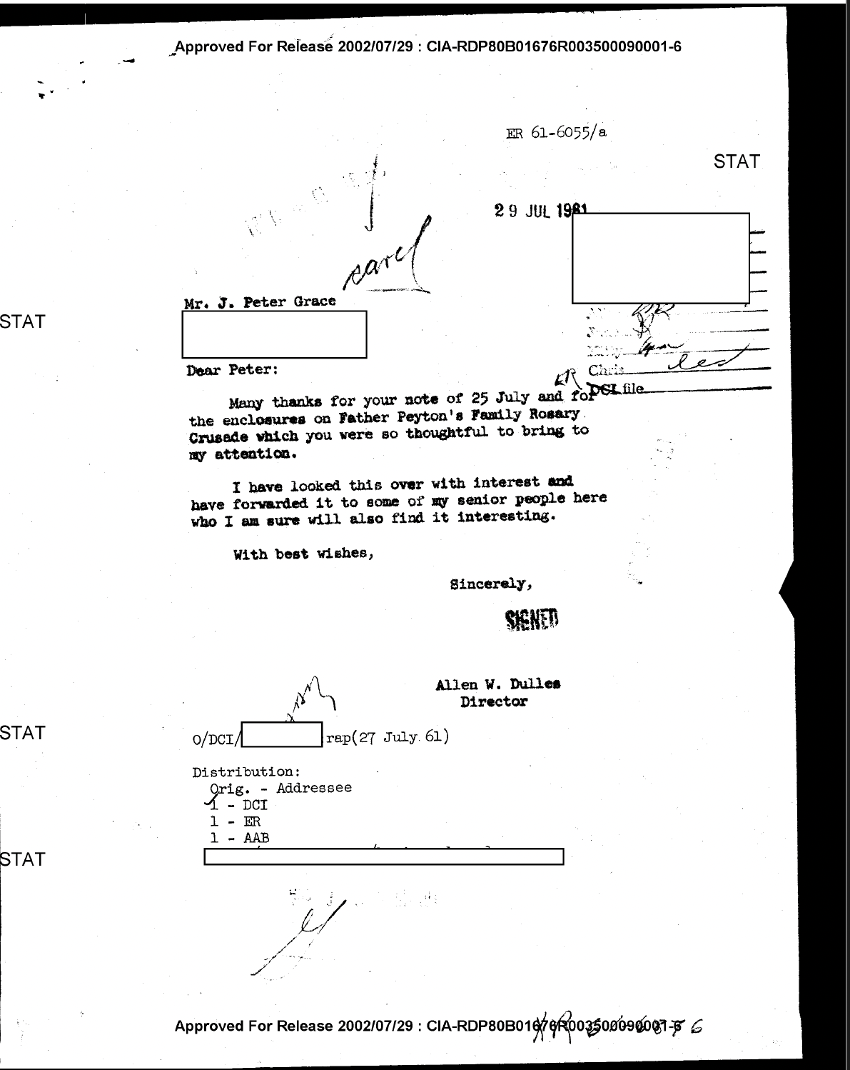
That the CIA funded the marches’ organisers was no coincidence; a connection between the Family Rosary Crusade and the intelligence service was established by Peter Grace, an American businessman whose chemicals company, W R Grace & Co, had operations in Brazil and throughout Latin America. Grace was a personal friend of the then CIA director, Alan Dulles, and “a devout Catholic”, Pereyra says.
Grace met Father Peyton on a boat trip to Europe and, impressed by his work in spreading the faith, became his main financier and, more importantly, his intermediary with the US intelligence services. It was he who proposed bringing the Crusades movement to Latin America, an initiative that received support from both the CIA and the Vatican.
One of the most revealing documents from Pereyra’s investigation shows that Grace mentioned the need for a meeting between Father Peyton and the CIA, demonstrating that the connection between religion, the business world and US intelligence was neither informal nor accidental.
The Vatican was then facing two challenges in Latin America: a shortage of clergy and the rise of left-wing movements. The convergence of religious interests and US geopolitical objectives gave rise to an alliance in Brazil in which funding came from Washington, whilst the public face was religious.
The clergy, through archbishops and bishops, facilitated contact with the faithful, the movement’s fundamental support base.
The invisible orchestration
According to Pereyra’s research, the CIA not only provided funding for the marches – it even determined where they should be directed.
“Every time they arrived in a town, dinners were organised with business leaders and the media. Links were established with trade and industrial associations, and numerous letters were sent,” he explains.
The funding did not come solely from the CIA. Major US corporations and Brazilian businessmen also contributed funds. The Alliance for Progress, a US economic cooperation programme with Latin America launched in 1961 by President John F. Kennedy, served as an additional channel for funding.
There was a narrative that permeated all the campaigns, a phrase that appeared in documents of the time: “The real revolution was made by your mother”. This discursive construction allowed women to exercise political power without this being recognised as such, and enabled the CIA to operate through religious and family structures, avoiding the appearance of external intervention.
According to Cordeiro, this strategy was effective: “The mobilisation legitimised the coup [of 31 March 1964], which was presented as a response to popular demand”.
The legacy of a fateful march
To understand how the Family Rosary Crusades and, later, the March of the Family with God for Freedom found fertile ground in Brazil, one must take into account the context of political polarisation that marked the beginning of the 1960s.
The Goulart government faced a powerful coalition of conservative and ultra-reactionary forces. The reforms he had proposed deeply displeased conservative sectors. Restrictions on the remittance of profits abroad affected multinational companies. Agrarian reform terrified the landowners. The mobilisation of trade unions and workers, coordinated by the General Workers’ Command, frightened the bourgeoisie.
Against this backdrop of political radicalisation, the Family Rosary Crusades offered a framework that allowed reactionary sectors to express their concerns in religious and family terms, rather than purely economic or political ones.
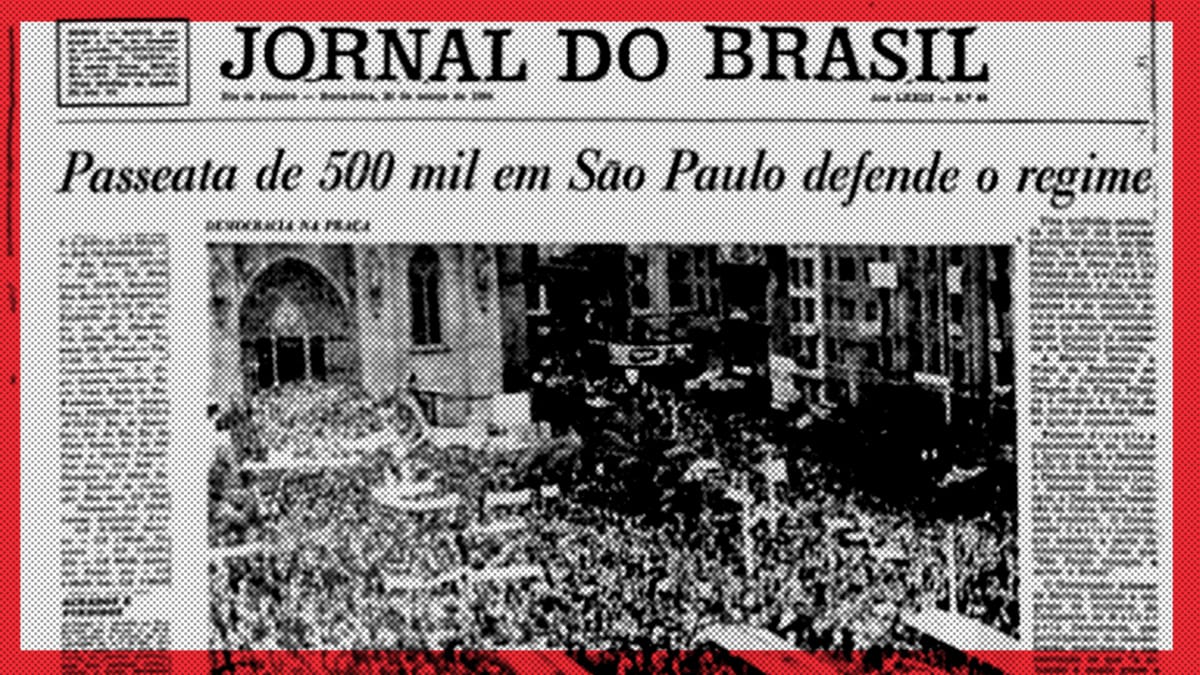
The historian Boris Fausto told Agência Pública in 2019 that the march demonstrated that the coup enjoyed significant social support in urban areas, particularly among the middle and upper classes, but he cautioned that “there is a huge gap between that and considering it a movement representative of society as a whole”.
The press, with rare exceptions such as Samuel Wainer’s newspaper Última Hora, played a crucial role in creating a climate of fear, amplifying the discourse of the “red menace”. O Estado de S. Paulo, for example, published the manifesto calling for the march, openly aligning itself with the conspirators.
“There was no real threat that a communist regime was going to be established,” stated Fausto. What existed was political radicalisation and a dispute over the direction of national development. The 1964 coup, far from being a mere “barracks coup”, was a civil-military alliance that took the democratic forces by surprise and established itself with absolute force. The dictatorship, which lasted until 1985, revealed the true nature of the movement.
When the Family March ended in the early evening of 19 March and the Sé Cathedral was celebrating the last mass of the day, the fate of Goulart’s government was sealed. Twelve days later, the coup would be consummated. The march had provided the civilian backing the military needed to act.
The first march in São Paulo served as the spark. In Rio de Janeiro, a march had been planned for 2 April, but the coup was brought forward to 31 March and took place on 1 April, transforming the demonstration into a ‘Victory March’. The march in Rio brought together some 800,000 people, according to the most conservative estimates, whilst in São Paulo the figure was 500,000.
Cordeiro highlights the scale of this mobilisation: “The march in Rio was the largest of them all. From then on, those marches became celebrations.” And the phenomenon spread across the country: “apparently, Brazil marched right through to September.”
The atmosphere in March 1964 was electric, historian Jacob Gorender recalled in 2017 in an interview with Agência Pública about the eve of the military coup.
Operation Brother Sam, directed by Washington, put the US Navy and Air Force in a position to intervene in Brazil should the coup face armed resistance or lead to a civil war. Direct intervention was not necessary, but the presence of the US fleet off the Brazilian coast served as a guarantee that the plan to oust Goulart would not fail. The overthrow of the legitimate government was a priority in the logic of the Cold War, in which the rhetoric of the ‘red menace’ justified the suppression of democratic freedoms.
But the enthusiasm of many participants would soon turn to disillusionment. Sectors of society that supported Goulart’s downfall, believing in a brief intervention to “restore order”, found themselves trapped in an authoritarian regime that would last 21 years.
Within four years, many of those who had marched with rosaries in their hands would be on the streets again, this time to protest against state violence. The dictatorship that followed Goulart’s presidency suppressed freedoms, decimated Parliament, and persecuted and tortured opponents, even killing them, as depicted in two films from recent years, I’m Still Here and The Secret Agent.